
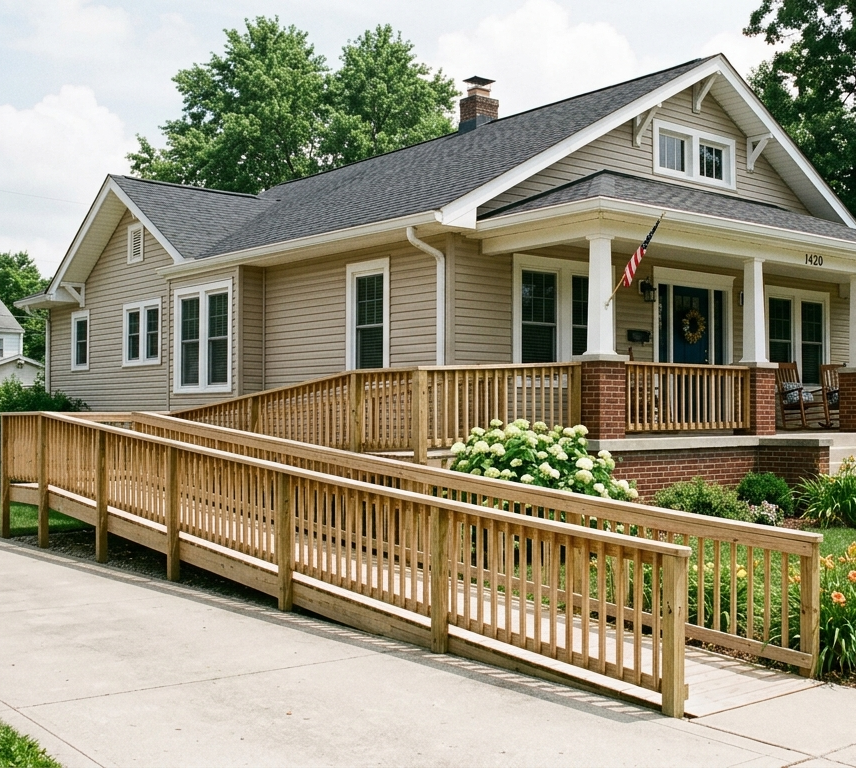
Access Without Barriers or Compromise
Handicap Ramps in New Albany for properties requiring safe, independent entry and exit
Railing systems fail when weight shifts unevenly across incline transitions, and pre-fabricated kits rarely account for landing dimensions required by actual door swing patterns. NXT LVL Remodels builds handicap ramps across Southern Indiana using measurements taken from threshold height, door clearance, and the turning radius needed for walkers or wheelchairs. Every installation addresses the specific grade limitations and landing space your property layout allows.
Ramp construction involves calculating rise-to-run ratios that comply with accessibility standards while fitting within your available yard space or entry area. The process includes anchoring support posts below frost line depth, installing handrails at heights that accommodate different user grips, and surfacing with slip-resistant materials that remain functional during wet weather or temperature changes common to this region.
Schedule a site evaluation to determine ramp length, landing placement, and structural requirements for your entry configuration in New Albany, Bedford, Bradenburg, KY and surrounding areas.
What Proper Ramp Installation Requires
The difference between a stable ramp and one that shifts within months comes down to foundation depth and how landing platforms distribute weight at directional changes. Your installation includes pressure-treated framing that resists moisture damage, galvanized fasteners that prevent rust-related loosening, and surface boards spaced to prevent water pooling while maintaining smooth wheel travel.
After completion, you'll notice railings remain solid when gripped during ascent, landings provide space to pause without repositioning mobility devices, and the incline allows controlled movement without excessive effort. The ramp surface stays level across its length, preventing the tipping sensation that occurs when boards warp or supports settle unevenly.
Ramp configurations vary based on whether your entry requires a straight run, L-shaped turn, or switchback design to achieve the necessary length within your property boundaries. The approach also accounts for whether the ramp serves temporary medical recovery needs or permanent accessibility, which affects material selection and structural reinforcement decisions.
Questions Property Owners Ask Before Installation
Families and business operators throughout Southern Indiana and neighboring Kentucky communities often want to understand how ramp construction affects daily property use and what separates durable installations from temporary solutions.
How is ramp length determined for my specific doorway?
The calculation starts with measuring the total rise from ground level to your threshold, then applies the slope ratio required for safe wheelchair or walker use—typically one foot of ramp length for every inch of rise, though steeper slopes are permissible for short distances if handrails are installed on both sides.
What makes railings stable enough for full weight support?
Railing posts are set into concrete footings or through-bolted to structural beams rather than surface-mounted, and the rail height is positioned between 34 and 38 inches to accommodate users of varying stature who apply downward pressure while pulling themselves up an incline.
How does weather in this region affect ramp materials?
Southern Indiana experiences freeze-thaw cycles that cause untreated wood to crack and metal to expand, so construction uses pressure-treated lumber rated for ground contact, aluminum railings that don't corrode, and fasteners with weather-resistant coatings that maintain grip strength through temperature swings.
When should I add a ramp instead of modifying existing steps?
Ramps become necessary when users cannot safely navigate steps due to mobility limitations, balance concerns, or the need to move wheelchairs and walkers without lifting, and when property layout provides enough linear space to achieve a compliant slope without excessive platform height.
What's included in a customized ramp design?
The design process measures your door swing clearance, identifies obstacles like utility meters or landscaping that affect placement, determines whether you need straight or turning sections, and specifies landing sizes that allow users to rest or maneuver before entering the doorway.
NXT LVL Remodels works with families and businesses throughout the area to create ramp solutions that match specific mobility requirements and property constraints. Request an accessibility consultation to discuss layout options and material selections for your entry configuration.